

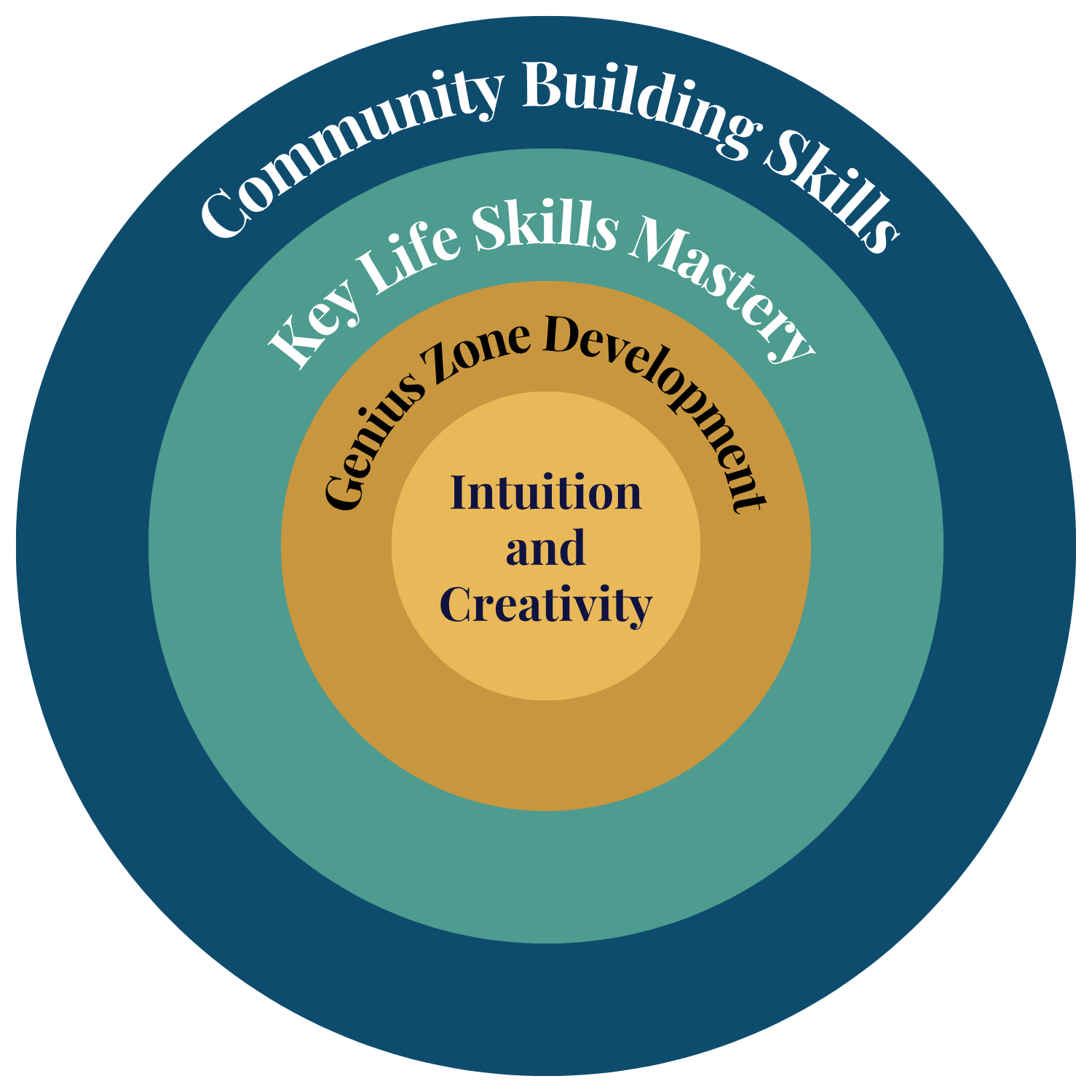
Last week I showed you the four circles — our answer to the question nobody with authority over your child’s 15,000 hours has seriously asked since 1893: what’s actually worth learning?
Today we go to the center of the circles: Intuition & Creativity. And I want to start with the study I promised — the one that should stop every parent cold.
The 98% Problem
In 1968, NASA had a problem worth envying: rooms full of brilliant engineers, and no way to tell which ones were the inventive ones — the minds you point at the impossible. They brought in two researchers, George Land and Beth Jarman, to build a test for creative, divergent thinking. It worked so well that Land had a bigger thought: where does this capacity come from?
So he gave the same test to 1,600 children, ages four and five.
98% of them scored at the level NASA called “creative genius.”
Then the study did something almost accidental and became one of the most quietly devastating findings in education. They tested the same children five years later, at age ten: 30%. At fifteen: 12%. Among adults? 2%.
Buckminster Fuller saw it before the data existed. “All children are born geniuses,” he said. “9,999 out of every 10,000 are swiftly, inadvertently degeniusized by grownups.”
He was barely exaggerating. Land’s conclusion from the numbers was just as blunt: non-creative behavior is learned. We don’t grow out of creative genius. We are schooled out of it — a dozen years of being rewarded for the one right answer, in a system built to sort for compliance, does exactly what it was designed to do.
Notice Fuller’s word, though: inadvertently. Nobody sets out to de-genius a child. It happens the way erosion happens — 15,000 hours of small corrections, one “stop daydreaming” at a time.
Sit with that for a second. We spend billions on programs to teach adults “innovation” — trying to reinstall at 40 what was standard equipment at 4.
Why This Is the Innermost Circle
Of the four circles, why does this sit at the center — deeper than the Genius Zone, deeper than life skills?
Two reasons.
First, everything else draws on it. A Genius Zone project without imagination is just an assignment. A career without creative capacity is just a job description waiting to be automated. The inner circle is the fuel for every outer one.
Second — and this is the one I’d tattoo on every school door — it’s the part AI can’t touch. In the last two years, machines have gotten frighteningly good at the exact things school optimizes for: recalling facts, producing correct answers, formatting five-paragraph essays. The 1893 curriculum is now a list of things a free chatbot does faster than any straight-A student.
What the machines don’t have is what your four-year-old has in abundance: original imagination, inspiration that arrives from somewhere beyond the training data, and the felt sense of knowing that precedes reason. In the Age of AI, the inner circle isn’t enrichment. It’s the whole ballgame.
The Age-Seven Window
Here’s the part developmental science has understood for decades and school has ignored just as long: young children aren’t just “little adults with less information.” Before roughly age seven, a child’s brain spends most of its time in slower brainwave states — the same states adults have to meditate their way back into. It’s why a five-year-old doesn’t pretend the cardboard box is a spaceship. For her, right then, it is one.
That window is when the imaginative, intuitive channel is wide open — and when it’s most vulnerable. Every worksheet that interrupts a deep game of pretend, every early lesson that the right answer matters more than your answer, is a small training in closing the channel. This is the de-geniusing, up close. It has no villain — just a curriculum running on autopilot since 1893.
You can’t blame teachers — they’re running the program they were handed. But you can build a school that runs the opposite program. So we did.
What We Do Instead
At Coherence Education, the inner circle isn’t a Friday-afternoon art slot. It’s structural:
We start every day inside. Our mornings open with coherence practice — students learn to settle their nervous systems, drop into their hearts, and listen before the day asks anything of them. (Fun fact: researchers at HeartMath have spent years studying the heart’s role in intuitive perception. The kids just call it “getting coherent.”)
We treat intuition as a skill, not a superstition. Games and exercises that ask kids to sense before they think — then talk openly about what showed up. No pressure, no grades, lots of laughter. The skill grows exactly the way a muscle does.
We protect imagination like the asset it is. Unstructured creation time isn’t a reward for finishing the “real work.” It is real work. Some of the most impressive projects in our school started as what a traditional classroom would have interrupted.
And we never grade a child’s inner world. The fastest way to teach a kid to stop reporting what they sense is to red-pen it.
What happens when you do this for a while? In the next article I’ll tell you about one of our students whose intuition training started showing up in her projects — and what that did to the quality of everything she made. It’s my favorite story in the school.
How to Prevent the De-Geniusing, Starting This Week
You don’t need our school to start reopening the channel. Three small experiments:
Ask the question underneath the question. When your child faces a small decision this week, skip “what do you think?” and try “what does your gut say?” Then honor whatever comes — no correcting, no “are you sure?”
Leave the daydream alone. One time this week, when you catch your child staring out a window mid-task — let them stay there. That’s not attention failing. That’s attention arriving somewhere interesting.
Play “what else could it be?” Grab any object at dinner. Take turns naming what else it could be — the weirder the better, and the only rule is nobody says “that wouldn’t work.” That’s the NASA test, dressed as a game. Notice who wins. (It will not be the adults.)
NEXT UP: Circle two — the Genius Zone. How we help each child find the intersection of what they love, what comes easily, and what they care about most — and the student whose intuition training supercharged everything she built.
Want to see the inner circle in action? Join our next live Open House — Thursdays at 8:00 AM Pacific through July (Wednesdays at 9:00 AM Pacific starting in August). Register for an Open House here — or grab 10 minutes with me directly and let’s talk about your kid: Book a 10-minute call.
If this resonates, subscribe to follow the Inside-Out journey — and if you know parents wrestling with these questions, share it with them. ❤️