

Last time, I promised you the nuts and bolts of implementing Inside-Out Education — how it’s actually easier than the traditional way, with happier kids and better outcomes.
I’m going to keep that promise. But sitting down to write it, I realized there’s a question that has to come first.
Everything in my last article — flipping the classroom, coaching instead of explaining, teaching skills individually — was about how to teach. And the how matters. But you can run the world’s most beautiful classroom and still waste a childhood, if what’s being learned isn’t worth the child’s time.
So before the how: what should kids actually learn?
The Question Nobody Owns
Here’s an uncomfortable piece of history. The subjects your child studies — the math/English/science/history rotation we all accept like weather — were largely locked in place in 1893, by a group called the Committee of Ten. Ten university men, chaired by Harvard’s president, standardizing what American schools should teach.
They did their job well — for 1893. Their graduates needed to file, calculate, memorize, and follow written procedures in an industrializing economy. The committee built a curriculum for that world, and that world is gone.
The Carnegie unit came along thirteen years later to measure it all in hours of sitting (I told that story last time). And since then? We’ve added AP versions of the same subjects. We’ve digitized the worksheets. But nobody with authority over your child’s 15,000 hours has seriously re-asked the founding question: what, of everything a human being could learn, is most worth learning?
We’ve been arguing about the recipe for a century, without asking if we’re cooking the right dish.
The One Rule That Changes Everything
If my last article had a single load-bearing idea, it was this: people don’t retain what they don’t want to learn. Retention from lectures runs around 5% — and that’s when the student has some reason to care. Content a kid finds pointless doesn’t get learned slowly. It doesn’t get learned at all. Ask any adult to solve the quadratic equations they “learned” for six years.
Take that rule seriously and it transforms the “what to teach” question. You cannot start with a committee’s list and push it into the child from the outside — 130 years of red ink prove it. You have to start with what’s already alive inside the child, and build outward.
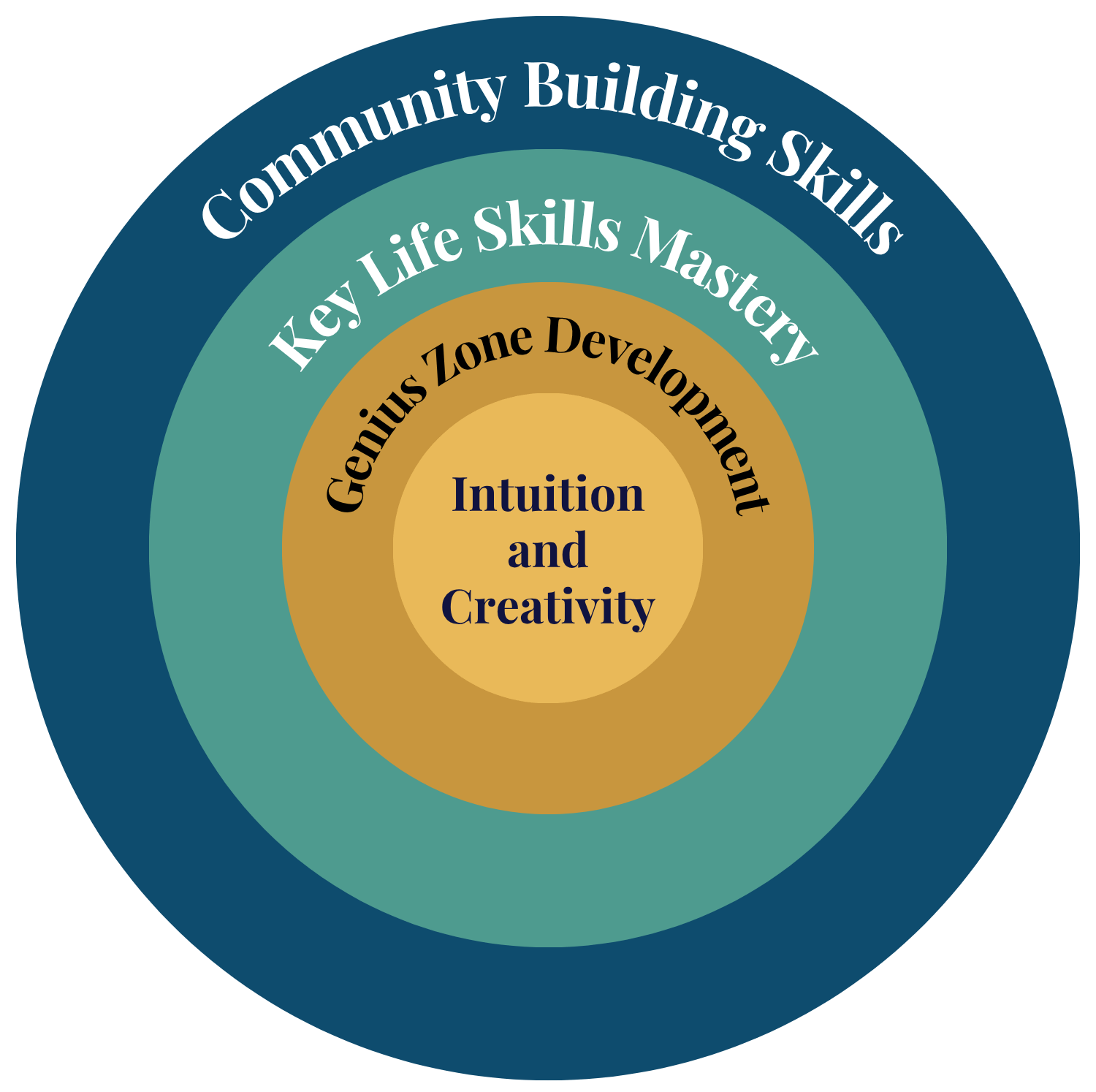
That’s not a metaphor. It’s an architecture. Ours looks like four concentric circles.
The Four Circles
At the core: Intuition & Creativity. Every child arrives with a live connection to imagination, inspiration, and knowing-beyond-reason — the capabilities every great inventor, artist, and leader draws on, and the ones no AI can replicate. School, mostly by accident, trains these out (there’s a NASA-derived study on this that should stop every parent cold — it opens the next article). We put them at the center, protect them, and actively develop them.
Circle two: The Genius Zone. Every child has one — the intersection of what they love, what comes naturally, and what they most deeply value. Instead of assigning generic projects, we help each kid find that intersection and then build real things from it: businesses, books, musicals, apps, documentaries. This is where “make them learn” becomes “try to stop them.”
Circle three: Key Life Skills. Career. People. Money. Health. The very skills adults spend hundreds of billions a year trying to learn after school failed to teach them — taught here in childhood, in age-appropriate ways, by people who live them. Genius that can’t navigate the world stays stuck in a bedroom. Ours won’t.
Circle four: Community. The ability to live with, lead, and build groups of humans who work and play well together. As the big top-down systems strain under their own weight, I believe community is the next stage of our evolution — and it’s a skill set, not a sentiment. I’ve lived the difference between communities that thrive and ones that tear themselves apart, and I’ll tell you those stories.
Why the Order Matters
The circles aren’t a menu. They’re a sequence — each one feeds the next.
A child with activated creativity and intuition brings uncommon spark to their Genius Zone projects. A child with a thriving Genius Zone has a reason to master money, communication, and health — the life skills stop being abstract because they’re in service of something the child already loves. And children who’ve mastered all three inner circles grow into exactly the kind of adults who can build communities that don’t collapse — people who create together instead of bickering, back-biting, and power-positioning.
Notice the direction: inside → out. The child’s inner world first, the world’s demands last.
Now look at the traditional model. It runs the arrow the other way — it starts with what the system needs (compliant workers, sortable test scores, seats filled for 120-hour units) and works inward, hoping something sticks to the child. Outside-In education, for an Outside-In world that’s disappearing.
That’s the whole disagreement, in one arrow.
Where We’re Going
Over the next four articles, I’ll take you around the circles one at a time — what each layer is, why it matters more than ever in the Age of AI, how we develop it at our school, and what you can do at home this week, whatever school your child attends:
Intuition & Creativity — the 98% problem, and the age-seven window
The Genius Zone — how we find it, how we feed it, and what happened when one student’s intuition training supercharged her projects
Key Life Skills — why our geniuses will be buttoned-up about career, people, money, and health
Community — my two favorite living situations ever, and the Harmonic Age
In the meantime, here’s a dinner-table experiment: ask your child, “If school didn’t exist, what would you want to get really good at?” Then just listen. Whatever they say — that’s the inside. That’s where we start.
NEXT UP: Your child was born a NASA-grade creative genius. Here’s the study that proves it — and the schooling that un-teaches it.
Want to see the four circles in action? Join our next live Open House — Thursdays at 8:00 AM Pacific through July (Wednesdays at 9:00 AM Pacific starting in August). Register for an Open House here — or grab 10 minutes with me directly, and let’s talk about your kid: Book a 10-minute call.
The modern American family didn't just naturally drift toward screens—it was subjected to a coordinated, structural override. The Left used educational policy to isolate the child from the parents, and the Right deregulated the tech industry to sell that isolated child to the highest bidder. The result is an $11 billion annual harvest of the adolescent retina. We traded the American living room for a digital Skinner box. Read the full structural breakdown of how state policy and Big Tech domesticated our kids:https://triggledger.substack.com/p/captive-audience-the-unregulated?utm_source=share&utm_medium=android&r=8gc1qf
"We've been arguing about the recipe for a century without asking if we're cooking the right dish." The prior question — what is education actually for — keeps getting deferred in favor of arguments about method and measurement. Starting from what's already alive inside the child rather than from what the system needs to sort and certify feels like the only honest place to begin.