

When I was growing up in the ‘60s, my parents threw the occasional cocktail party, and I got a front-row seat to how grown-ups behaved when they thought no one was watching.
Everyone looked fantastic. The men could have walked off the set of Mad Men; the women were Audrey Hepburn or Elizabeth Montgomery from Bewitched. The style was impeccable. The behavior was anything but.
The men talked rough to each other, one-upping with their latest business conquest (or other kind of conquest), pinching the women as they passed, trading the latest ethnic joke to a chorus of “ha-ha.” The women rolled their eyes and put up with it, then turned to gossip brutally about whichever woman hadn’t shown up.
I remember it so clearly because my parents thought it would be cute to have their eight-year-old tend bar. So there I stood, pouring hard liquor for adults who guzzled it, feeling like I was watching a dystopian TV show unfold in my own living room. I remember thinking, Is this really what it’s like to be a grown-up? (Yes, if this happened today, someone could rightfully call Child Protective Services.)
College in the ‘80s wasn’t much better. The thing to do on a weekend, as a young man, was go to a bar, get drunk and try to pick up women. I went to bars with live bands because I love music, and I’d stand there aghast at what was happening around me: alcohol-fueled fistfights (sometimes between the young women), and the endless, clueless peacocking of guys trying to get lucky.
Every one of those scenes ran on the same zero-sum game: if I win, you lose. If you win, I lose.
School taught us the game
School reinforced that belief system at every turn. Students competed against each other on a bell curve for grades, or at tryouts for the varsity team. Land in the top 10%? You got the A, you made the team, you were in the popular crowd. You were a winner. Land in the other 90%? You were a loser, and the winners would never let you forget it.
When you remember that our education system was designed in 1893 to produce efficient factory workers, you can see that this was the perfect design for the job. Competition maximized output and rewarded the alphas.
I’ve always been a gentle soul. Watching rude and mean behavior produced the same reaction in me that I’d had behind that bar at eight years old: a deep concern for the state of humanity, and a strange out-of-body feeling of watching a world in which I couldn’t believe human beings could act so inhumanly.
Then something shifted
Here’s what strikes me now: how far we’ve come.
If you watch mainstream news, we’re more racist and sexist than ever. Open your eyes and actually look around, though, and that is so far from the truth.
In 2018 I was at the Eclipse Festival in central Oregon, solidly in my fifties, surrounded mostly by twenty-somethings. And instead of the alcohol-fueled aggression I remembered from my own twenties, I found masses of young men and women packed into the yoga tent, or soaking up talks on permaculture and tantra. The drug of choice was ecstasy, and although I’ve never tried it, I swear I got a contact high from thousands of people vibrating at the frequency of love. The dancing during the EDM sets was about self-expression and connection, through gentle eye contact and contact improv.
Eating in the café area, I overheard two young men comparing the different styles of yoga and meditation they’d tried and which worked best for them. I thought about my own upbringing, where my peers ridiculed me for my daily meditation practice.
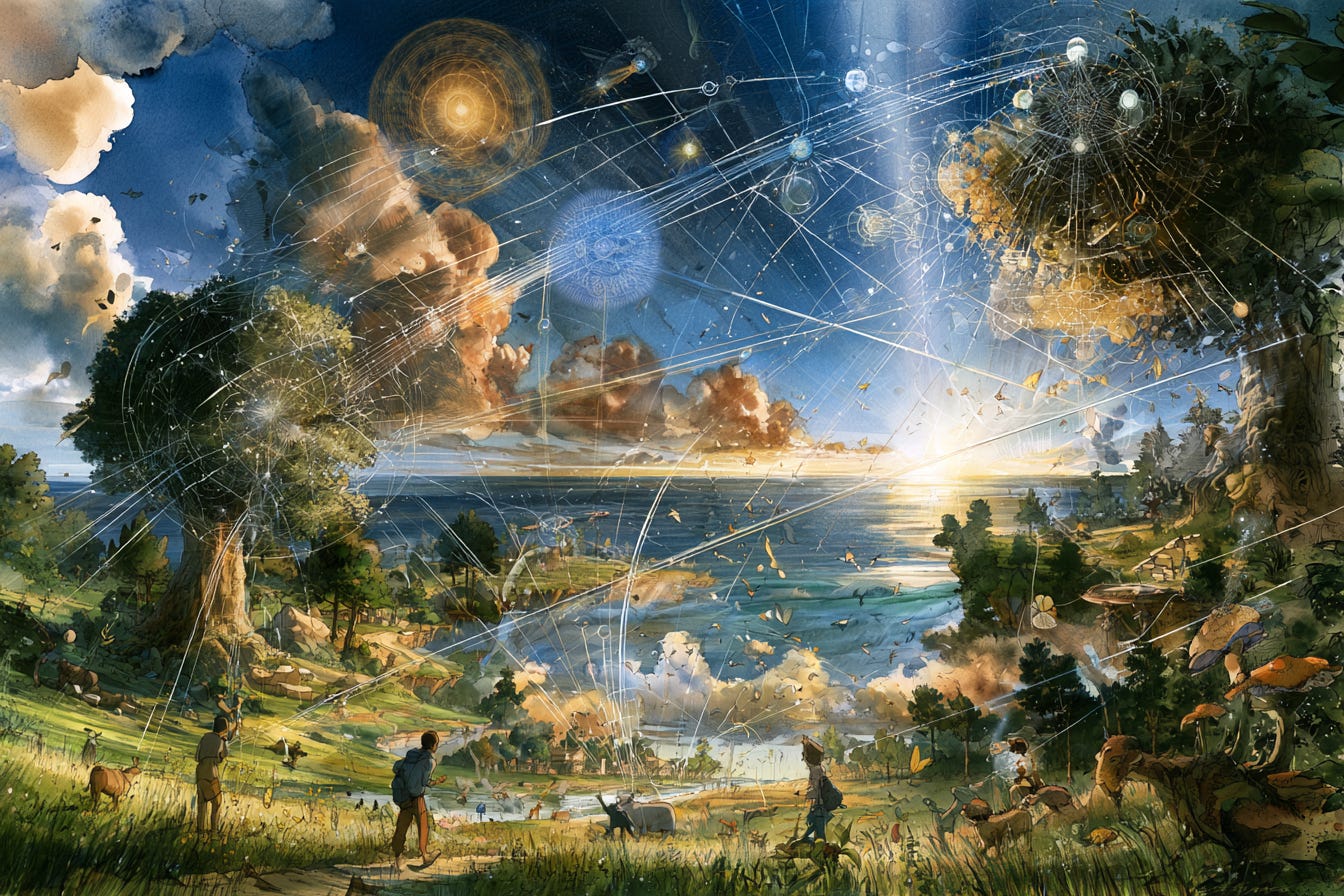
It hit me: we had crossed into a new age. An age where people feel and express love, cooperate rather than dominate, and actively seek to expand their consciousness and raise their vibration.
Is there still aggression, violence, racism and sexism in the world? Of course. But I liken it to the hot spots after a forest fire. They’re still burning, but instead of the whole forest being ablaze, they’re isolated pockets that are gradually cooling. Those hot spots are also the sole focus of mainstream media, so if you’re sitting in the living room with CNN on, that’s all you’ll ever see.
What this means for our kids
Most of the parents I talk to are scared. The future is changing faster than anyone can track, with AI driving a level of acceleration that makes the Internet revolution look gentle by comparison. Parents are worried their kids will be stranded in a future with no place for them.
I believe that is the furthest thing from the truth.
The catch is that our kids can’t do it the old, lazy way: get trained for a technical vocation, collect the paycheck, shuffle the same papers every day, especially in a vocation outside their Genius Zone. We were told constantly to “be practical.” I nearly went the CPA route myself because it promised steady income, and I can tell you there is no job on earth further outside my Genius Zone than accounting.
Those jobs are going, going, gone. AI is already better, faster and cheaper than any human at those technical ‘turn-the-crank’ jobs, and no amount of “practical” will bring them back. And was it really ‘practical’ to become a wage slave in a soulless job anyway?
My friends Marshall Lefferts and Teresa Collins call the next phase of humanity the Harmonic Age, and I can’t think of a better name for it.
In the Harmonic Age, the unconscious automaton has no role. What’s needed instead is exactly what school has spent a century training out of us: intuition, creativity, a developed genius, and the ability to combine it with other people’s.
Kids who have grown up through the four circles of Inside-Out Education — Intuition & Creativity, Genius Zone, Key Life Skills, and Community — are Harmonic Age ready. They won’t compete with AI. They’ll partner with it, using it to accelerate the innovative solutions and human leadership they bring into the world.
The Harmonic Age is waiting to be filled with healthy, joyful geniuses playing a non-zero-sum game: vibrating and harmonizing with one another to create the Eclipse Festival at scale. Not for a long weekend in the Oregon desert, but as the way we live our daily lives.
Our kids are the ones who will build it. Our job is to get out of the way and give them the tools.
Where to begin
Next week’s article is about the concrete steps you can take at home to prepare your kids for the Harmonic Age, whether you homeschool, unschool or send them to a traditional school. In the meantime, try these three this week, one for each of the inner circles:
Intuition & Creativity. Tonight, ask your child a gut-level question with no right answer (”What does this room want to be?” “What’s your body telling you about tomorrow?”), and don’t correct the answer. Just listen. This is the muscle our Align and Shine and Deep Coherence classes train every morning.
Genius Zone. Ask your kids what they’d build if school didn’t exist tomorrow, and write down the first three things they say without comment. Then take the Genius Zone survey together for ten project ideas that match: https://coherenceeducation.org/genius-zone
Life Skills & Community. Let your kids teach you something this week — anything — and treat it as real. Ask questions, get it wrong, let them correct you. Teaching is the fastest route to mastery, and being taken seriously is the fastest route to confidence.
If you’d like to see what this looks like in a live classroom, join us for the Open House this Thursday at 8am Pacific, and have a look at the Fall à la carte classes, which start Monday, September 21st: https://coherenceeducation.org/a-la-carte-classes
The forest is cooling. Let’s raise the kids who’ll plant what grows next.
With love and appreciation, Andrew