

Two riddles.
Riddle one: Sudbury Valley School’s founder reported teaching kids the entire K-6 arithmetic curriculum — six years of material — in about twenty contact hours. Traditional schools take twelve years to teach math, and (as we’ll see in a moment) mostly don’t succeed. Why?
Riddle two: A student can take French classes for six years, land in Paris, and be unable to order lunch. An immigrant kid dropped into the same city is fluent within a year — with no classes at all. Why?
There is clearly a disconnect between what we call teaching and actual learning.
The dictionary says teaching is imparting knowledge — structuring experiences so a person learns something new. Learning is acquiring knowledge or skill through study, experience, or instruction.
Notice those definitions describe two different people doing two different things. That gap is where twelve years can disappear.
The Scoreboard
You don’t have to dig deep to see how much teaching is happening — and how little learning.
The primary objective of K-12 education is kids who can read and do math. How’s that going? Per the 2024 Nation’s Report Card, roughly 7 in 10 eighth graders are not proficient in reading, and nearly 3 in 4 are not proficient in math — after nine years of daily teaching.
Adult education is an industry worth hundreds of billions of dollars a year — and the bulk of it is basic life skills: managing money, managing people, managing health, managing a career. Adults are paying to learn, between job and family pressures, what school had them for 15,000 hours and never taught.
And if the purpose of college is preparing kids for the real world: 52% of graduates are working high-school-level jobs, 50% of 18-29-year-olds live with a parent, 54% have at least one chronic disease, and 42% of twenty-somethings deal with depression.
I know, I know — I’m not a career teacher. I don’t even have a teaching certificate. But I’ve spent three years running a school where kids love showing up and learn at a remarkable pace, and from inside that experiment, I want to offer some observations about how we close the teaching/learning gap.
Explaining Is Not Teaching
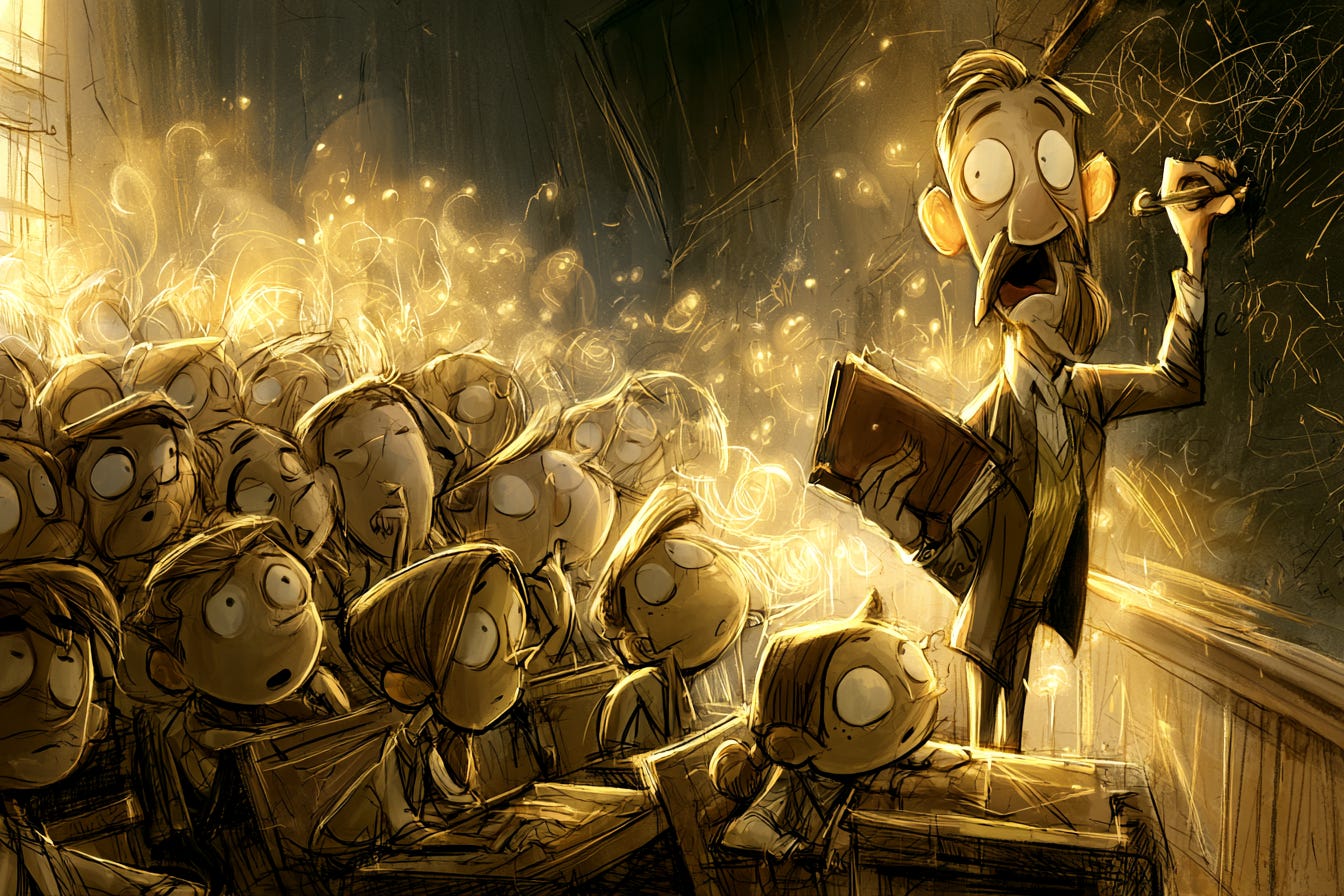
The classic model: teacher stands at the front and explains what’s in the textbook. Kids go home and do the exercises alone, at night, as homework.
There are a few problems with this.
People learn by doing, not by listening. The famous “learning pyramid” puts retention from lectures at around 5%. Researchers argue about the exact percentages — but nobody argues about the ranking. Listening is the worst way to learn anything. Doing is the best. At 5%, a five-hour school day yields about fifteen minutes of retained material.
We learn what we want to learn — and tune out the rest. Remember that mandatory HR training you had to sit through? How tuned in were you? What do you remember, other than plotting your escape?
Teachers are more useful as coaches than as explainers. Here was my nightly routine as a kid: open the textbook, look at the homework exercises, and have no idea what to do. Yes, the teacher “explained” it all in class — but the sliver I retained wasn’t enough to even get started. So I’d read the chapter and teach myself. I was stubborn enough to do that. I imagine a lot of kids just throw in the towel — night after night, year after year.
Khan Academy figured this out years ago, and it’s worth repeating: flip it. The lecture can be a recording watched at home — no live teacher required. The doing happens in the classroom, where a live teacher can coach kids through the sticking points. The teacher stops being a broadcast tower and becomes what they were always most valuable as: the person in your corner when you’re stuck.
Knowledge Is a Group Sport. Skills Are Solo.
Knowledge — concepts, theories, facts — can be taught in groups. Grammar, biology, geography, history: one teacher, many students, works fine (as long as nobody’s lecturing).
Skills cannot.
Michael Jordan didn’t learn basketball in a classroom. Neither did any great artist, musician, writer, or engineer. They built their skill individually — challenging themselves at their own edge, harnessing a feedback loop, learning from each miss.
Back to our riddles: French is a skill. Math, past the basics, is a skill. We teach them like knowledge, in rows of desks, and then wonder why six years produces nothing a summer of immersion couldn’t beat.
Looking back, my most hated classes were exactly the ones where a skill was taught as a group subject — math, gym, music. Here’s the tell: I loved math, sports, and playing instruments when I was on my own.
Why Kids Cheat With AI
I recently attended a roundtable of educators discussing AI in education. Ninety percent of the conversation was about catching kids who cheat with it.
Not one person asked why kids want to cheat.
Ask the question differently: why are kids finding so little value in what we’re teaching that their main goal is finding the most efficient way to get it over with?
Here’s the case-in-point from inside our school. In our Genius Zone Project Rooms, kids are welcome to use AI. Very few do. When a kid genuinely loves what they’re making and can feel themselves getting better at it, the last thing they want to do is outsource it. (The exception proves the rule: our young entrepreneurs use AI constantly — as the low-cost startup team they get to direct.)
Kids don’t cheat on things they love. Cheating is a pain-avoidance strategy. Which raises the question: why is school painful?
Hours Are Not Outcomes
Here’s a fact that should make everyone cringe: we literally measure education in units of sitting.
The standard currency of American schooling is the Carnegie unit — 120 hours of seat time equals one credit, and 20-24 credits equals a diploma. Four years of English-hours, three of math-hours, three of science-hours. Nobody asks what you can do — the diploma certifies how long you sat.
And the punchline: the Carnegie unit wasn’t designed to measure learning at all. It was created in 1906 by the Carnegie Foundation as an accounting standard — adopted because universities had to use it to qualify their professors for Carnegie’s new pension system.
Your child’s education is measured in an accounting unit invented for retirement plans, one century and one technological revolution ago.
As the scoreboard above shows: the hours are being served. The learning isn’t happening.
Coercion Runs Out
When I came home from my rough first day of first grade, my dad explained the deal (I told that story here): we put up with painful, boring school because good grades lead to a good college, which leads to a good job, which leads to a good life.
Bad grades, on the other hand, carry shame. Red ink. Mocking classmates. Uncomfortable meetings with parents and principals.
So the goal of school quietly becomes achievement to avoid pain — not learning. And a kid optimizing to avoid pain will, quite rationally, hand the pain to a machine. That’s the AI-cheating “crisis” in one sentence.
Coercion can produce compliance for a while. It cannot produce learning that lasts. And in the Age of AI, compliance is precisely the skill that’s being automated first.
Teaching Is Selling
“Whoa — did he really say that?”
Yes. I sure did. Stay with me.
What do great salespeople actually do? They qualify the prospect, so nobody’s time gets wasted. They ask questions to understand what the person actually needs. If there’s no fit, they move on — gracefully, because a “no” is just a “not now.” And when there is a fit, they show the person exactly how the thing improves their life, and let them decide.
Notice what a great salesperson never does: force anyone to sit through six years of a product they didn’t choose, can’t use, and will be punished for ignoring.
So what would teaching look like if it worked like selling?
Qualification: Do you want to learn things that will take you to a different future — or are you content where you are?
Discovery: What does that future look like? What would you need to know, and be able to do, to get there?
The offer: Here’s the most efficient path we can build to that future. Want to see it?
The negotiation: the knowledge and skills get fine-tuned to the kid — not the kid to the curriculum.
The decision: if the student sees enough value in their future self, and the cost in time and effort is acceptable, they choose to move forward.
The service agreement: frequent check-ins, course corrections, and a plan that keeps earning its place — because the customer can always walk.
A student learning this way is never exposed to material that’s a detour from their goal. They’re invested in the outcome, because it’s their outcome. Practice stops being homework and becomes satisfying progress. And here’s the beautiful part: real goals pull in breadth all by themselves. A kid set on becoming a concert violinist discovers she needs teamwork, music theory, money management, history, persuasive speaking to win the orchestra seat and conscious communication to keep it.
No coercion required. The future she wants does all the motivating.
The Name for All This
Focus on outcomes instead of hours. Coach instead of explain. Teach knowledge in groups and skills individually. Sell — don’t sentence.
That’s what you get when you design education around how learning actually works. It’s what I’ve been calling Inside-Out Education — and after three years of running a school on it, I can report: the kids learn faster, love school, and are becoming exactly the creative, self-directed humans the Age of AI will demand.
NEXT UP: The nuts and bolts of implementing Inside-Out Education — how it’s actually easier than the traditional way, with vastly better outcomes and much happier kids (and parents).
If this resonates, subscribe to follow the Inside-Out journey — and if you know parents wrestling with these questions, share it with them. ❤️
Andrew, this article captures something I have observed again and again throughout my 40+ years as a teacher — in schools, colleges, universities, and teacher-training institutions: more teaching does not necessarily produce more learning.
The distinction you make between teaching, learning, coaching, and actual skill development is especially important. Many of the most valuable human capacities cannot be developed simply by explanation. They require experience, practice, feedback, confidence, and a learner who is personally engaged.
This is particularly true in areas such as attention, perception, inner imagery, intuition, body awareness, and consciousness-based learning. These are not subjects that can be absorbed by sitting passively and listening. They have to be explored from the inside out.
That is why I find your phrase “Inside-Out Education” so powerful. It suggests an education that begins with the learner’s own experience, curiosity, perception, and future possibility — rather than with a fixed curriculum imposed from the outside.
I also appreciated your point that teachers are often more valuable as coaches than as explainers. In my own work with children and adults in non-ordinary perception, right-brain learning, and whole-brain education, I have seen the same principle: the facilitator’s role is not to force an outcome, but to create the right conditions, guide the practice, observe carefully, and help the learner trust what is emerging.
This may be one of the great educational shifts of our time: moving from instruction to activation, from compliance to curiosity, and from hours spent to capacities awakened.
Thank you for articulating this so clearly.