


In his book Outliers, Malcolm Gladwell popularizes the 10,000-Hour Rule, which posits that achieving true mastery and world-class expertise in any complex skill requires roughly 10,000 hours of practice.
How much time did we spend in school, counting class time and homework?
17,000 hours through high school
5,000 hours in college
This means we spent enough time in school to achieve true mastery and world-class expertise.
TWICE. With 2,000 hours left over for the basics: reading, writing and arithmetic.
So, what two fields did you achieve true mastery and world-class expertise in during your 22K+ hours?
What’s that you say? None?
Unfortunately I’m right there with you. When I think back to my school years and what I learned in those 22,000 hours of classroom time plus homework, I struggle to find anything that directly contributed to success in the things that matter: career, relationships, money or health.
I learned all of the most impactful skills and knowledge after school – on the job, through my own study of scores of books, workshops and classes, or through the hard knocks of life. And many of those knocks came precisely BECAUSE I entered the real world unprepared.
Not every learning hour is created equal
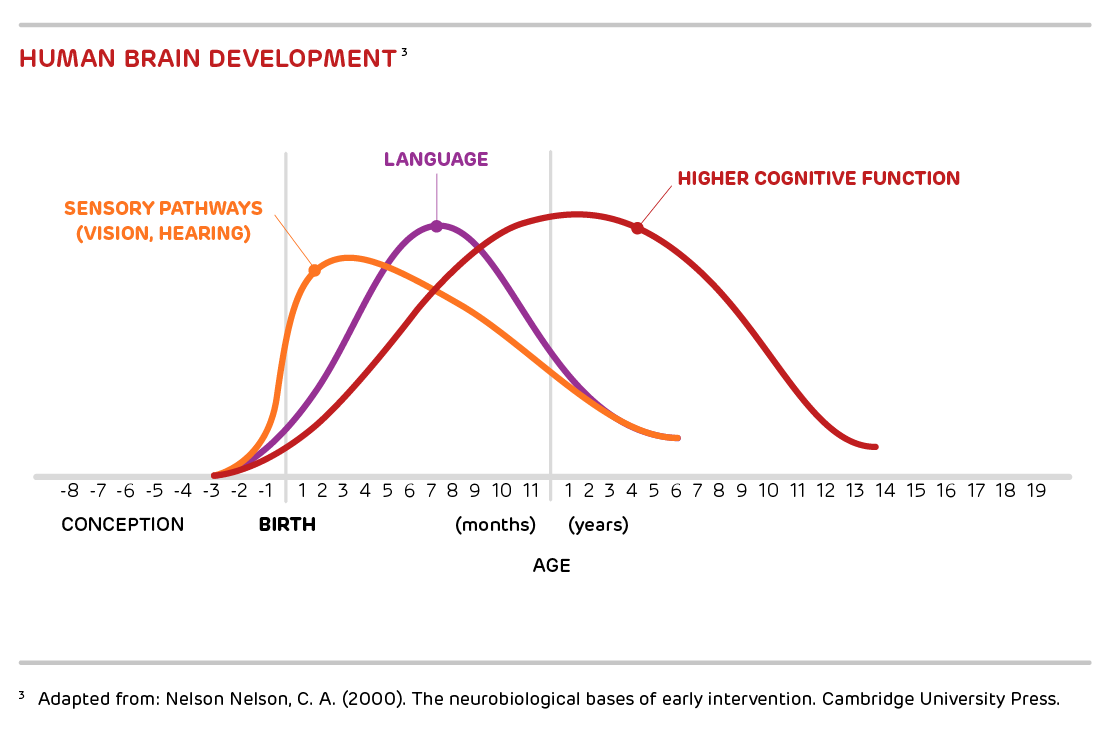
From the time we’re born until we’re 18, our brains are wired for learning.
One hour of learning for a kid is WAY different from one hour of learning for an adult.
Children’s brains are built for flexibility and rapid absorption (neuroplasticity). Adult brains are built for efficiency, execution and specialized processing.
A child’s brain is a highly adaptable blank canvas. An adult’s brain is a finely tuned, deeply grooved highway system.
It’s no secret that what we learn as kids goes into our minds and bodies differently. Learn a language, a sport, an instrument or a dance as a kid and it becomes part of you. Learn it as an adult and it often stays foreign and clunky.
As we move into adulthood, our brains shift from eagerly forming new synapses to pruning the little-used ones in order to create those efficiencies.
Yes, we’re doing it backwards
Looking at the way our brains work, it would make sense for:
Kids to focus on learning the skills and abilities that will set them up for success in life
Adults to take those mastered skills and refine them in order to succeed in a competitive world
Instead, we do the opposite:
Kids are taught how to get through large volumes of mostly irrelevant work efficiently, within a highly competitive environment
Adults must scramble to learn the key life skills related to career, people, money and health WHILE they’re in the thick of navigating them.
If adult life is an airplane taking off into the real world, ideally we would have spent our childhood building the plane and mastering how to fly it. Instead, we enter adulthood unprepared.
It’s like we’re building the airplane while we fly it.

What did we really learn in school?
The one thing school did teach me was how to endure doing things I didn’t want to do and saw no reason to do.
In essence, I learned how to grind.
Is that a valuable skill? Yes. There are times in our lives where we need to put our noses to the grindstone. However, I believe you can learn to grind while developing your genius, and while you’re grinding you’ll actually know why you’re doing it.
What about math?
Which brings me to the question I hear most from parents thinking about taking their child out of traditional school.
What about math? Math is a nice skill to have. We use it for cooking, managing money and running our businesses. Is it absolutely necessary? No… The best math genius in the world is within arm’s reach, accessible through your computer or phone.
If you think math is so important, let me ask you. When was the last time you did math? If you suddenly lost your ability to do math, how would your life change? Probably not at all.
The reason most parents want their kids to know math is because it will be on their college entrance exams.
But how many hours does it take to learn that math?
At Sudbury Valley School, a group of students famously mastered the entire six-year elementary math curriculum in just 20 contact hours spread over 20 weeks, or 5 months.
So then… why did we go to school?
If school isn’t about preparing us for the real world, what is its purpose?
Many argue that our school model was originally designed to train kids to become compliant factory workers. However, your kids were born during a time when factory jobs had been shipped overseas, so that is no longer school’s purpose.
The real reason? It’s to gain access… to the next school.
I was told that if I did well in grade school I’d be prepared for middle school, then high school, then college, then grad school.
So, the reason we were told to do well in school was not to gain knowledge. It was to gain access.
In my first Substack article, “School Has Become an Unwinnable Game,” I compared the school system to a multi-level video game. Make it through your level and your reward is access to the next one. Just like Super Mario Bros.
The big prizes used to be college, grad school and a good job. If you played the game well, access to a high-paying career was guaranteed.
That’s no longer the case.
A 2024 report from the Burning Glass Institute and Strada found that 52% of four-year college grads were underemployed a year after graduating, working jobs that don’t require a degree. And that was before AI started gobbling up entry-level jobs and internships like Ms. Pac-Man eats dots. AI has barely warmed up.

Getting out of college today is a bit like the nightmare where you step into the elevator expecting to go up to the next level, but you realize the car isn’t there and instead you step into the void.
That’s the real-life nightmare more than half of college graduates are experiencing today.
Fewer employers care about college
Elon Musk has been blunt about this for years. “You can learn anything you want for free,” he says. Colleges are “basically for fun and to prove you can do your chores.” What he asks of job applicants is “evidence of exceptional ability,” and in his words, “I don’t consider going to college evidence of exceptional ability.”
If it’s not your genius, it’s not your job
I heard that saying at a workshop for entrepreneurs.
If bookkeeping, marketing or cleaning your office aren’t your genius, outsource them and free up time to do the work that is your genius.
In the Age of AI, the saying has become literal. If a job isn’t within your genius zone, it isn’t yours. In fact, it will soon no longer even be an option for it to be yours.
With the latest AI agents and bots, you can easily employ a bookkeeper, a marketer, even a chief of staff essentially for free. For a person trying to work in one of those jobs and to be worth hiring, they’d better add value beyond what AI can, by creating, innovating and thinking outside the box in ways AI can’t.
In short, if you’re trying to work outside of your genius, you will have no job.
What does this mean for our kids?
Let’s use those 22,000 hours to ensure they build mastery in two areas:
10,000 hours developing their unique Genius Zone. They’ll enter adulthood ready to use it to make money, solve problems, and create new solutions.
10,000 hours to master the key life skills around career, people, money and health.
2,000 hours to learn the ‘nice-to-haves’, like math, history, geography, foreign languages, etc. The key here? Let the child choose the things they are interested in, so they actually learn them.
This doesn’t just give our kids an airplane to fly into adulthood. It gives them a rocket ship!
This is how we change the world
In the old model, where we were encouraged to choose a ‘practical’ path towards getting a job just to get a job, most of us felt hollow. This is why I believe so many adults and kids turn to alcohol, drugs, porn and other numbing distractions. We’re trying to not feel that nagging, hollow place inside of us that is asking, “What are you doing with your life?”
Now think of the people you know who do live from their Genius Zone and Path-of-Purpose. What are they like? Chances are they have that sparkle in their eyes and the vibrant energy and health that comes from the passion of living on-purpose.
We know which future we want for our kids. We want our kids to be happy, healthy and thriving.
So there’s no time to waste. Especially not 22,000 hours of it.
Interested in seeing what an education that focuses on developing each kid’s unique Genius Zone and Path-of-Purpose looks like?
Check out our website and join our next Open House, every Thursday at 8am Pacific register here, or explore our Winter Quarter classes, which begin the week of January 11 (see the lineup).
From the inside out,
Andrew

Hi, I’m Andrew Freeman, founder of Coherence Education and the Inside-Out approach to education.
I heard the call to help transform education for kids early in life, but I didn’t know how to answer it. So I spent a career in tech instead, at Microsoft, Hewlett-Packard, Netscape and a string of startups. Then Covid hit, and it became obvious that I needed to pull my eight-year-old out of second grade. Since then I’ve been building the kind of school that will prepare him, and thousands of other kids, to thrive in the age of AI.
Every few weeks I publish an article introducing a piece of my upcoming book, due out in early 2027. If you’re a parent who wants something better for your child, or an educator looking for a better place to do your work, I’d love to hear from you. Drop me a message.
Together we’ll help children grow into their best human selves and help usher in the coming Harmonic Age.
Thank you.
P.S. Where the numbers come from: A typical U.S. public school runs about 180 days a year at 6.5 to 7 hours a day, which comes to roughly 13,000 to 15,000 hours across grades 1–12 (Pew Research, Education Next). Parents report 4 to 5 hours of homework a week in elementary and middle school and 6 to 8 in high school, which adds another 1,800 to 2,800 hours (NCES). Together that’s roughly 15,000 to 18,000 hours. The college figure assumes a full-time load of about 40 hours a week of class and study over four academic years. These are ballpark numbers that vary by state, school and student.