

Part 3 of the Inside-Out Circles of Development: Key Life Skills
First, a quick refresher on how the Inside-Out Circles of Development work.
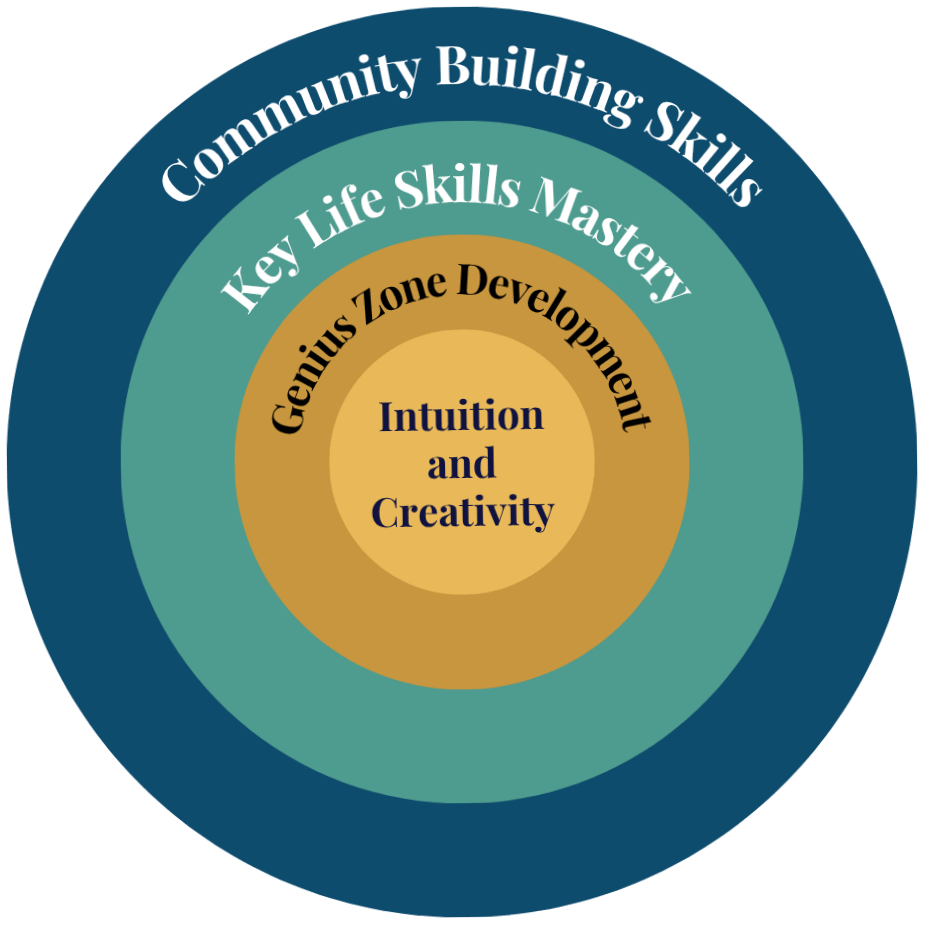
The Inner Circle — Intuition and Creativity. These are our great human differentiators from AI, which makes them the most valuable currencies our kids will carry into adulthood in the Age of AI.
The Genius Zone Circle. Creativity and intuition feed each child’s unique Genius Zone. We find the project that makes a kid’s eyes light up, then develop that genius through two hours a day of mentored, project-based learning. Kids who grow this way enter adulthood with a developed, marketable, unique genius.
The Key Life Skills Circle. Skills in Career, People, Money, and Health are what allow a genius to actually reach the world. We all know brilliant people whose gifts never made it out the door because these skills were missing.
The Community Skills Circle. The only thing better than living in your own genius is combining it with others’ — teams of unique geniuses working with AI to become world-builders and problem-solvers. That’s the dawn of what were calling the Harmonic Age: an era of sustainable, accelerated thriving.
Today’s article is about that third circle — Key Life Skills — because it’s the one that can unleash our genius into the world, or become a tragic, cautionary tale.
The geniuses we lose
We’ve all known geniuses who were held back by poor skills in career, people, money, or health. Schools don’t teach these skills. I’ve known many geniuses in my life. Here are three whose gifts the world never fully received.
The athletic genius. My high school was an athletic powerhouse — 4,500 students, a lucrative property tax base, and serious money pouring into sports programs. Just surviving the tryout gauntlet and getting onto a varsity team put you in reach of state championships and scholarship offers. The program produced numerous pro athletes over the years.
The most jaw-dropping talent I knew was a guy named Craig. He was like a mini Bo Jackson — speed, coordination, leaping ability, a cannon of a throwing arm. His body would simply do anything he asked of it. He’d stroll into a track meet and dominate multiple events.
The problem? Craig never trained. He didn’t listen to coaches. He showed up late to practice, when he showed up at all. The desire was there — but at the college level, where he finally met athletes with his talent and also a work ethic, he was quickly eclipsed. Craig never learned key life skills around health. He died of a heart attack in his mid-50s.
The career genius. Sean was one of the smartest people I met in my first job at HP — good-looking, charming, supremely confident, with the gift of gab. In meetings he ran mental circles around the rest of us, spinning keen strategies on the spot. Career-wise, the sky was the limit.
Except Sean had terrible people skills. Once the glow of his first impression wore off, people realized he cared only about himself. The end came when he and his married boss — long suspected of having an affair — arrived late to work a few minutes apart wearing each other’s name badges. Neither was fired. But the broken trust turned two brilliant careers into immediate dead ends.
The leadership genius. Sue, who ran the marcom department was the finest leader I’ve ever encountered — warmth, humor, keen intelligence, and a huge heart. Her staff would walk through walls for her, because they loved and trusted her so much.
But Sue had never been given the tools to care for her own health. She battled serious health problems and long absences for years, riding cycles of dramatic multi-hundreds of pounds weight losses and regains that her body ultimately couldn’t sustain. She died in her mid-30s, and she was truly mourned.
Oh, what could have been — for these three, and for so many geniuses we’ve all known whose gifts the world never got to enjoy.
The wakeup call comes too late
Here’s the thing: schools don’t teach the key life skills of career, people, money, or health. We’re expected to figure them out as adults — while also unlearning decades of ingrained bad habits and counterproductive beliefs.
And when do we finally decide to learn them? Almost always in reaction to a brutal wakeup call. Going broke. Getting fired. Getting dumped. Getting sick.
What if we learned these skills as kids instead? What if school treated them with the same seriousness as the three R’s?
Ask yourself how different your childhood — and your early adulthood — would have been if you’d been armed with:
Career skills for managing your time, projects, and goals as a kid. How easily would schoolwork and chores have gotten done — with SO much time left over to play and simply be a kid?
People skills for expressing your feelings and needs, truly listening, asking for help, negotiating outcomes, resolving conflict, gracefully declining invitations, and setting healthy boundaries. What would relationships with friends, teachers and family have been like?
Money skills — understanding early the quiet power of saving 10% of everything and putting it to work in compounding growth, setting you on a path to financial freedom and real wealth before most adults even start.
Health skills in nutrition, movement, and internal regulation — vital energy, a strong relationship and sense of pride with your body, and an unshakeable sense of internal well-being.
As adults, we can only imagine how different our lives would have been.
The great news: our kids are still kids!
It’s not too late for them. As adults we tend to shrug and “let kids be kids” — junk food, squandered time and money, no responsibility to themselves or others — because they’re just kids. But childhood goes by fast, and the Age of AI won’t wait. It’s our job to make sure our kids don’t enter it unprepared.
And if the inner circles — Intuition & Creativity, and Unique Genius — aren’t being developed in your kids yet either, it’s time to get those going too. Those are the most valuable currencies in the Age of AI.
If you’re looking for a strategy for the beloved children in your life, I’d love to help. Join our next Open House — every Thursday at 8am Pacific (register here) — or explore our Fall classes, which begin the week of September 21 (see the lineup).
~ The most expensive education is the one that doesn't prepare kids for the future.
Yours from the inside out, Andrew